How To Evaluate Acreage And Land In Chattahoochee Hills
June 18, 2026
June 18, 2026
Buying land in Chattahoochee Hills can feel simple at first glance. You see the acreage number, imagine the possibilities, and start picturing a home, barn, or long-term investment. But here, acreage is only part of the story. If you want to evaluate land wisely, you need to look at planning, access, utilities, and the actual buildable area before you decide. Let’s dive in.
In Chattahoochee Hills, land is evaluated through a preservation-first planning approach. The city’s comprehensive planning framework directs future growth into villages and hamlets, while much of the remaining land is intended to stay agricultural, conservation-focused, or very low density.
That means two parcels with the same acreage can have very different futures. One may align more closely with the city’s growth pattern, while another may be better suited for conservation, a single home, or agricultural use. If you are comparing properties, that distinction matters just as much as the size on the listing.
The future development map is an important guide in this process. It helps shape rezoning and development decisions, but it does not automatically rezone a property. Since Chattahoochee Hills is also working through a 2026 comprehensive plan update, it is smart to verify the current map set and ordinances rather than rely on older marketing materials.
Before you price the opportunity, confirm the parcel’s current zoning district and future development designation. Chattahoochee Hills includes districts such as Rural, Hamlet, Village, and Historic Crossroads, and each one points to a different use path.
For many acreage buyers, the Rural district will be especially relevant. The city’s Rural district summary notes a 20-acre minimum lot area for most Rural parcels, and the code recognizes uses such as single-family homes, agriculture, home occupations, and some uses that require additional approval.
If your goal is to build, hold, farm, or create a small project, zoning should be one of your first filters. A property may look ideal on paper, but the most important question is whether its zoning and policy designation match your long-term plan.
One of the biggest mistakes buyers make is treating total acreage as usable acreage. In Chattahoochee Hills, the real value often comes down to the buildable envelope, not the gross parcel size.
The city requires site analysis that identifies streams, stream buffers, wetlands, floodplains, steep slopes, trees, habitat, and other sensitive features. It also requires every platted lot to contain an adequate building site outside setbacks, buffers, flood plains, wetlands, steep slopes, and similar unbuildable areas.
So if a listing says 20 acres, that does not automatically mean 20 acres are practical for building or improvement. The usable portion can shrink quickly once natural features and code requirements are mapped.
The takeaway is simple: gross acreage starts the conversation, but mapped constraints finish it.
Topography plays a major role in Chattahoochee Hills land evaluation. The city’s physical landscape includes well-drained slopes near the river, rolling and hilly uplands, and areas with slopes greater than 15 percent.
That natural character is part of what makes the area appealing, but it can also affect grading, driveway design, drainage, building placement, and cost. In some cases, a beautiful tract may require a more careful site plan than a flatter parcel with less visual appeal.
Parcel shape matters too. Flag lots are strongly discouraged, and access standards can limit how easily a tract functions for everyday use or future division. Even when a property looks attractive from the road, its shape may reduce flexibility once setbacks, buffers, and access rules are factored in.
Access is not a minor detail in Chattahoochee Hills. It can directly affect what you are allowed to do and how much time and money it will take to make the property functional.
The city’s code requires connected, serviceable access. Mortgage lots need at least a 20-foot access easement to a public or private thoroughfare, and parcels with state-highway frontage need approval from GDOT and the zoning administrator before entrances, exits, or related land-use permits are allowed.
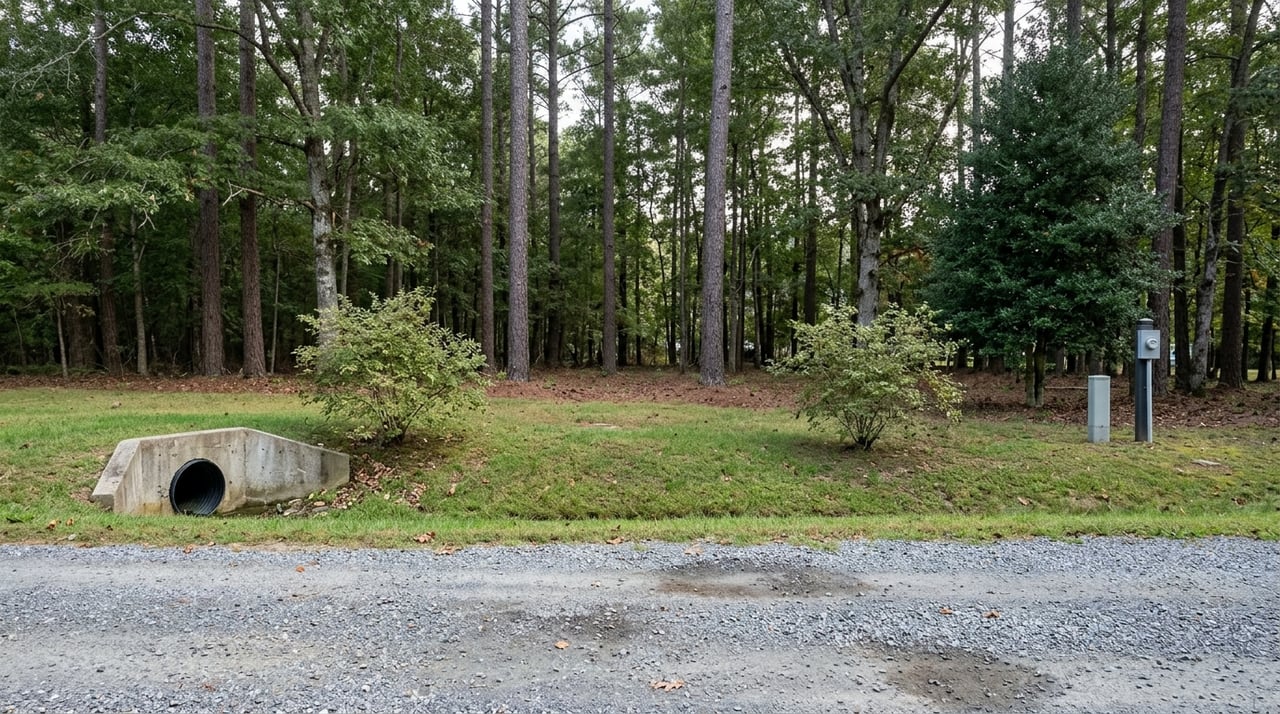
That means frontage alone is not the same as approved access. You should also confirm whether driveway, entrance, or culvert approvals will be required through public works, especially if the tract has limited frontage or touches a state road.
Many land buyers assume water and sewer can be solved later. In Chattahoochee Hills, that can be an expensive assumption.
The city states that it does not generally provide utilities such as water and sewer. On many properties, power is provided by Greystone Power, water may be available from Atlanta’s watershed system, more than half of the city relies on well water, and most of the city uses septic systems.
That does not make a parcel unusable. It simply means utility feasibility should be part of your early due diligence, not an afterthought after you go under contract.
Fulton County Health says private sewage disposal systems and water wells on property being sold in Fulton County must be evaluated by the county health department. For properties relying on private sewage or non-public water supplies in subdivisions, plat review materials and soil reports are also part of the process.
Georgia DPH recommends annual bacterial testing for private wells and chemical screening every three years. If a property depends on a well, that testing history is worth reviewing during due diligence.
The best parcel is not always the biggest one. It is the one that fits your plan with the fewest surprises.
If you want a single home with privacy, your checklist may focus on buildable area, driveway access, and septic feasibility. If you are looking for equestrian or agricultural land, use verification becomes even more important because the code recognizes agriculture, livestock, horses, farm buildings, and agritourism uses, while some agricultural housing beyond a single dwelling may require a special use permit.
If you are considering a small development angle, the path can be more layered. Farmette subdivisions are allowed only in the Rural district, and major projects in Hamlet, Village, or Historic Crossroads areas may need concept-plan approval.
This is where local guidance becomes especially valuable. A parcel may support your vision, but only after you confirm the approval path, map constraints, and utility setup.
When you evaluate land in Chattahoochee Hills, it helps to move in a clear order. That keeps emotion from outrunning the facts.
Check current zoning, the future development map, and any planning updates tied to the city’s ongoing comprehensive plan work. This helps you understand whether the parcel is positioned for preservation, limited residential use, agricultural use, or a more growth-oriented setting.
Look closely at surveys, easements, access easements, conservation easements, and any development-right considerations. These details can change how much control or flexibility you actually have.
Overlay setbacks, buffers, floodplain areas, wetlands, stream corridors, and steep slopes. This gives you a more realistic picture of what can actually be built and where.
Confirm whether the driveway approach works under current rules and whether public works or GDOT approvals will be needed. This is especially important for unusual parcel shapes or state-road frontage.
Order septic and well feasibility checks early if public service is not confirmed. If the land cannot support your utility needs, the acreage count will not solve that problem.
Make sure the property supports what you actually want to do, whether that is building a home, creating a horse property, holding land for the future, or evaluating a small investment opportunity.
Land in Chattahoochee Hills is not a simple price-per-acre exercise. The value of a parcel depends on how access, topography, utilities, planning policy, and preservation standards all work together.
That is why many buyers benefit from working with a team that understands acreage, horse properties, and special-use land in the southern Atlanta corridor. When you can evaluate the buildable area and approval path early, you can make a more confident decision and avoid expensive surprises later.
If you are comparing acreage, horse properties, or land opportunities in Chattahoochee Hills, RE/MAX Concierge can help you sort through the details with a practical, local-first approach.
Stay up to date on the latest real estate trends.
Want an agent who'll really listen to what you want in a home? Need an agent who knows how to effectively market your home so it sells? Give me a call! I'm eager to help and would love to talk to you.